
Projects
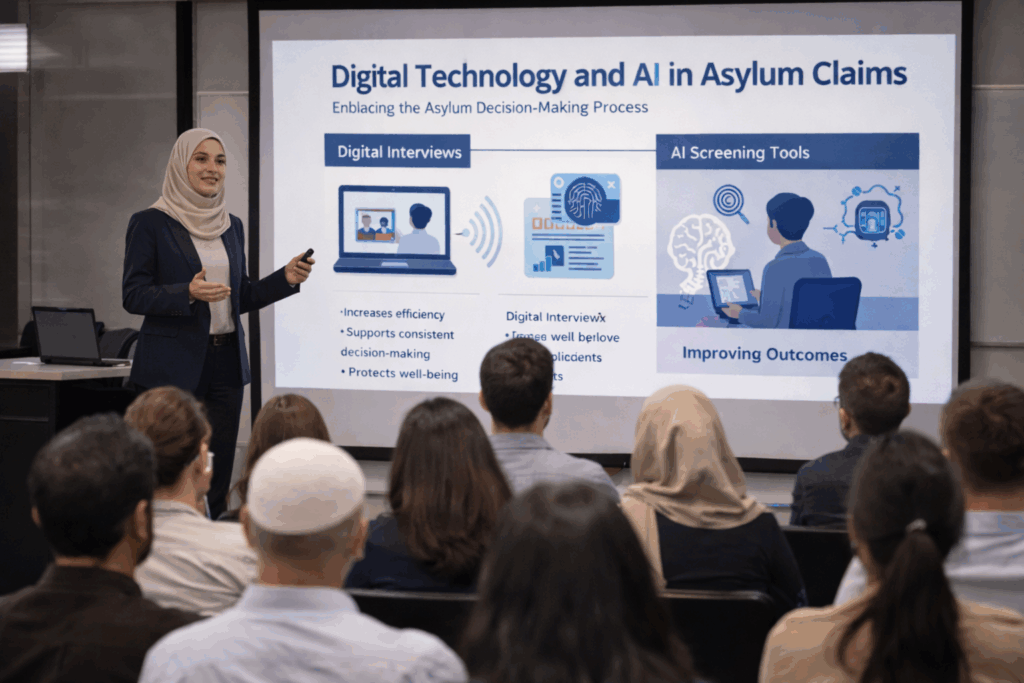
Launch of Infographic: Digital Technology and Artificial Intelligence in Asylum Claims
Prof. Amina Memon, Prof. Jill-Marshall and Dr. Zoe Given-Wilson
We developed an infographic, available in English, Farsi and Arabic, to be widely shared to help people understand how digital technology and AI are being used and provide practical steps. These can also be found with our Resources…

Remote Interviewing: Impact on Credibility of Online Platforms for Asylum Interviews
Prof. Hilary Evans Cameron
Professor Hilary Evans Cameron brought together a wide range of experts in the field of asylum including people with lived-experience of seeking asylum, academics, mental health profesisonal, legal and charity professionals in Toronto, Canada on 28th February 2025. The roundtable focused on examining how the use of remote interviews had influenced asylum interviews and crediblity assessment…

Use of Technology and Artificial Intelligence in Asylum Decision Making
Prof. Amina Memon, Prof. Jill-Marshall and Dr. Zoe Given-Wilson
Exploration of the rapidly expanding use of technology and artificial intelligence (AI) in the asylum context. This project will bring together people with first-hand experience of the asylum process, academics, asylum and tech industry professionals to explore the implications and ethics of harnessing technology in the complex cross-cultural setting of asylum determinations…

Understanding Support and Resilience for Police Officers Working Child Exploitation Cases
Zeast Kamal
This study seeks to understand how police officers investigating child exploitation cases manage the emotional demands of their work, focusing on the personal and organisational supports that best help them cope…
Psychology Research Evidence (PRE) Project
Prof. Hilary Evans Cameron and Dr. Jane Herlihy
Should a refugee status decision-maker expect that a claimant will remember the date of her assault? Should they expect that a claimant facing pressing danger would have fled at the first opportunity? How much consistency should they expect among the claimant’s various accounts of the same event? How much detail should they expect the claimant to remember?…

Denying Refugee Status: Inferences and Assumptions
Prof. Hilary Evans Cameron and Dr. Jane Herlihy
In Canada and elsewhere, most decisions to deny refugee status rest on a finding that the claimant was lying (Evans Cameron 2023). This project explores the law and psychology of deception judgments in the refugee status context…
Academy of Medical Sciences GCRF Network grant: Infusing Law and Policy with the Voices of Displaced Survivors of Sexual Violence in Conflict
Prof. Jill Marshall and Dr. Ndagire
Thanks to an amazing community of educators, activists and most importantly survivors of conflict related sexual violence (CRSV). This project involves listening to and learning from the lived experiences of those survivors in Uganda, home to the largest group of refugees in the world, having fled from many conflicts and countries in the region…

Ethics and the Law of Algorithms
Prof. Jill Marshall, Dr. Stefanie Kuenzel, Xiaoyu Zhang, Diego Martinez Castro and José-Rodrigo Córdoba-Pachón
The project team sought to explore what intricacies and issues emerge in diverse contexts when digital algorithms – computer programmes with ‘intelligent’ technologies like Artificial Intelligence, Chatbots, Datamining – are designed or tasked to manage if not predict the digital workload and behaviour of (a) households; (b) professionals, including within the legal community where human trust and relationships, confidentiality and judgement have been critical; and (c) marginalised communities (the unemployed, ill).